

Over the past few months, RAM and storage costs have risen sharply, pushing up the price of servers, laptops, and desktops. It’s not always obvious why, but much of it comes down to how the same materials are now being used differently.
Rising Memory Costs In Recent Months
In the last three months, RAM pricing has increased significantly. This has had a direct knock-on effect across servers, as well as end-user devices. What might appear as a simple price rise is actually part of a wider change in how hardware is being produced and prioritised. These increases are being felt across the board, not just in specialist systems.
Silicon underpins modern computing. It is refined into ultra-pure ingots, sliced into wafers, and used to produce both DRAM (laptop and server ram modules) for memory and NAND flash for SSD storage. For years, supply and demand remained relatively balanced, keeping pricing relatively stable. That balance has now shifted as demand has changed.
AI Is Changing How Memory Is Used
AI systems use memory in a fundamentally different way. To reduce data travel distance and improve speed, memory is placed directly within the chip module. This involves stacking multiple layers of silicon, sometimes up to 12 layers deep in newer designs. This approach increases both performance and the complexity of manufacturing.
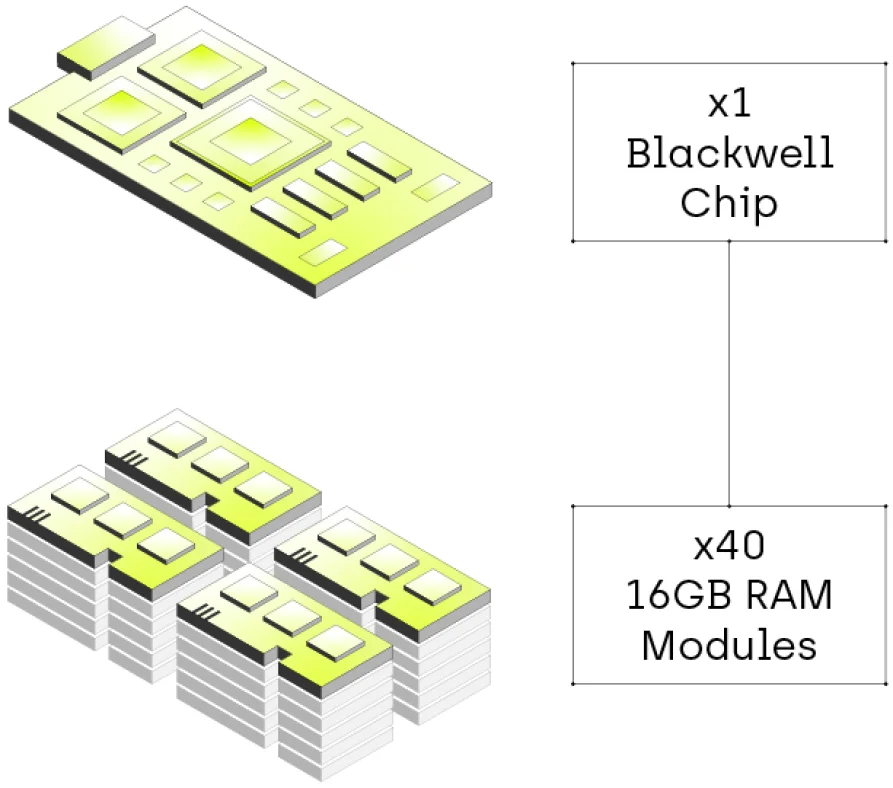
A single high-performance AI chip, such as the Nvidia Blackwell B300, can contain around 192GB of onboard memory. However, the comparison to standard hardware is not straightforward. The complexity of producing these chips significantly reduces manufacturing yield. In practical terms, one such chip can consume the same raw silicon that might otherwise produce 30 to 40 standard 16GB RAM modules. With a finite global supply of processed silicon, this creates a clear trade-off. Every time you make a Blackwell chip, up to 40 16Gb laptops loose their Ram.
Supply Shifting Towards AI Demand
As AI demand has accelerated, manufacturers have begun prioritising production for large-scale AI infrastructure. In late 2025, Micron Technology, known to many through its Crucial brand, reduced consumer-focused output to meet demand from hyperscale AI providers. This shift further limits availability for everyday hardware.
There is also a broader dynamic at play. For major players like Google, Anthropic, and OpenAI, access to compute is critical. Scaling AI services depends not just on software capability, but on securing enough hardware to support it. In some cases, competition is as much about securing supply as it is about advancing the technology itself.
Final Thoughts
Expanding silicon production is a slow process. New fabrication facilities take years to build and bring online. As a result, the current supply constraints are likely to continue into 2027. This is not a short-term fluctuation, but a longer-term shift in how global resources are being allocated. While these changes cannot be controlled, understanding the reasons behind them helps with planning. Better visibility over the “why” allows organisations to make more informed decisions around investment, timing, and lifecycle management.